Uncategorized

Standing Waves: a Multimodal Composition in the AlloSphere

This was my thesis project. You can find my presentation slides here.

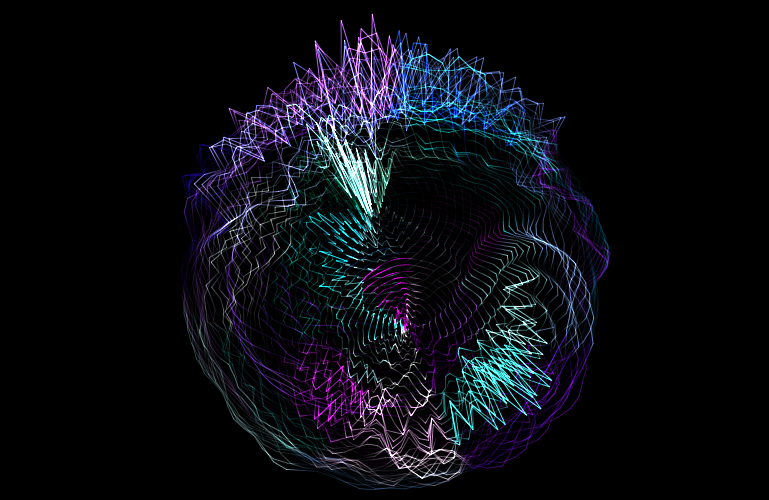
Standing Waves is an audio-visual installation designed for the AlloSphere, an immersive multimedia instrument being built at UCSB. The piece presents an interactive visualization of two-dimensional wave propagation projected in three dimensions around the surface of a sphere. This simulation is then sonified through a variation of additive synthesis and spectral decomposition, and the resulting audio is spatialized around the perimeter of the performance space.

Users are able to interact and control the combined audio-visual synthesizer through a motion-capture interface and gestural mapping system. The piece’s form is structured through a series of modules that can run while being guided by user input, as well as in a semi-autonomous “installation mode” when limited or no user interaction is detected.
Art Code

Harold Cohen’s Coloring Algorithm in C++

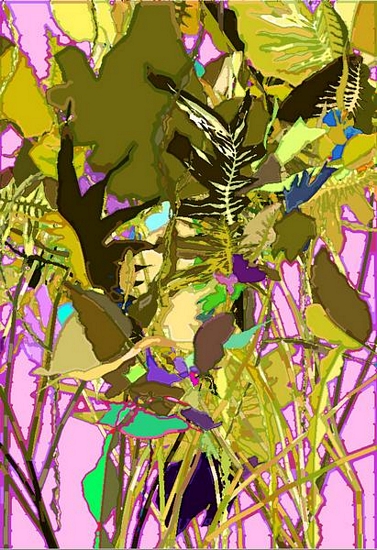
Harold Cohen’s coloring formula is a heuristic method by which to probabilistically control randomly generated color saturation, and lightness values.It has been used extensively by his AARON algorithmic painter, and is summarized in detail in the essay “Color, Simply,” 2006. I ported the algorithm into a C++ as a class which you can download here (relies on AlloCore currently. A standalone version is soon to come).
The algorithm can be described as follows:

  1. Three normalized number ranges are chosen, corresponding to low, medium, and high values. For example 0.15-0.35 (L), 0.4-0.65 (M), 0.8-1.0 (H)
  2. These are set up in a 3×3 matrix, each corresponding to a possible saturation-lightness pairing. For example, a low-low (LL) pairing would provide both saturation and lightness values chosen randomly from within the low range
  3. During initialization, a probability value is assigned to each of the 9 pairing possibilities inside of this matrix. Cohen suggests only using 2-3 of them per composition, for example: 20%-LL, 40%-HL, and 40%-MH
  4. When a new color is desired, one of these range pairs is selected based on its assigned probability, and then a specific saturation-lightness pair is chosen randomly from within each of the selected pair’s ranges.
Uncategorized

Kinematica at Bits and Pieces, Santa Barbara

Kinematica is a muti-person audio/visual motion capture installation. Taking hold of small infrared controllers, audience members are able to create light and sound through subtle movements of their arms and hands. This results in an electronic soundscape and visualization of human gesture. Because multiple participants interact with the system and each other throughout this process, the resulting audio-visual piece is a collaborative endeavor, similar to a live musical performance.

Art Music Voice of Sisyphus

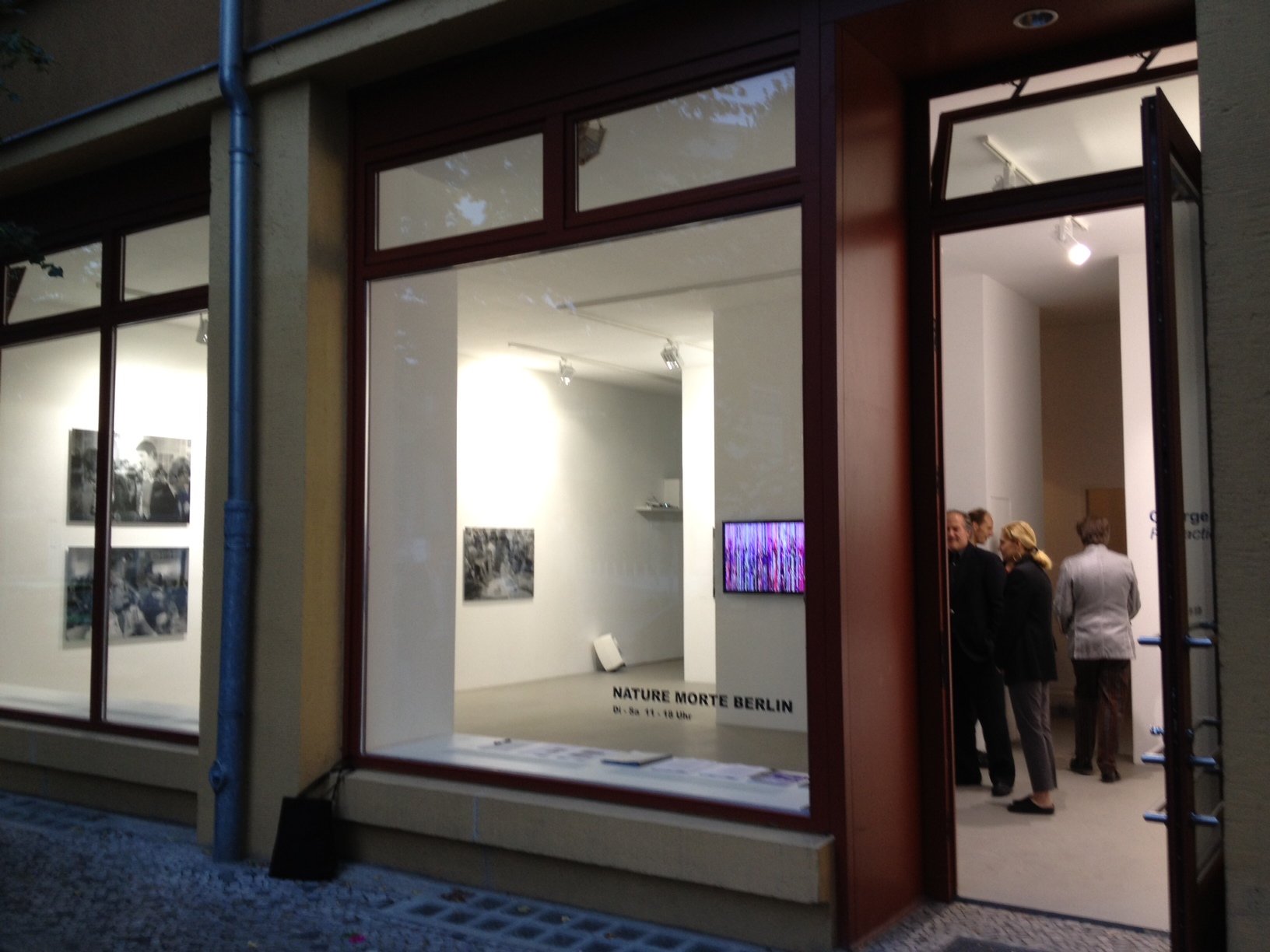
Voice of Sisyphus at Nature Morte Gallery, Berlin

Art Drip Music

Drip at Soundwalk, Long Beach

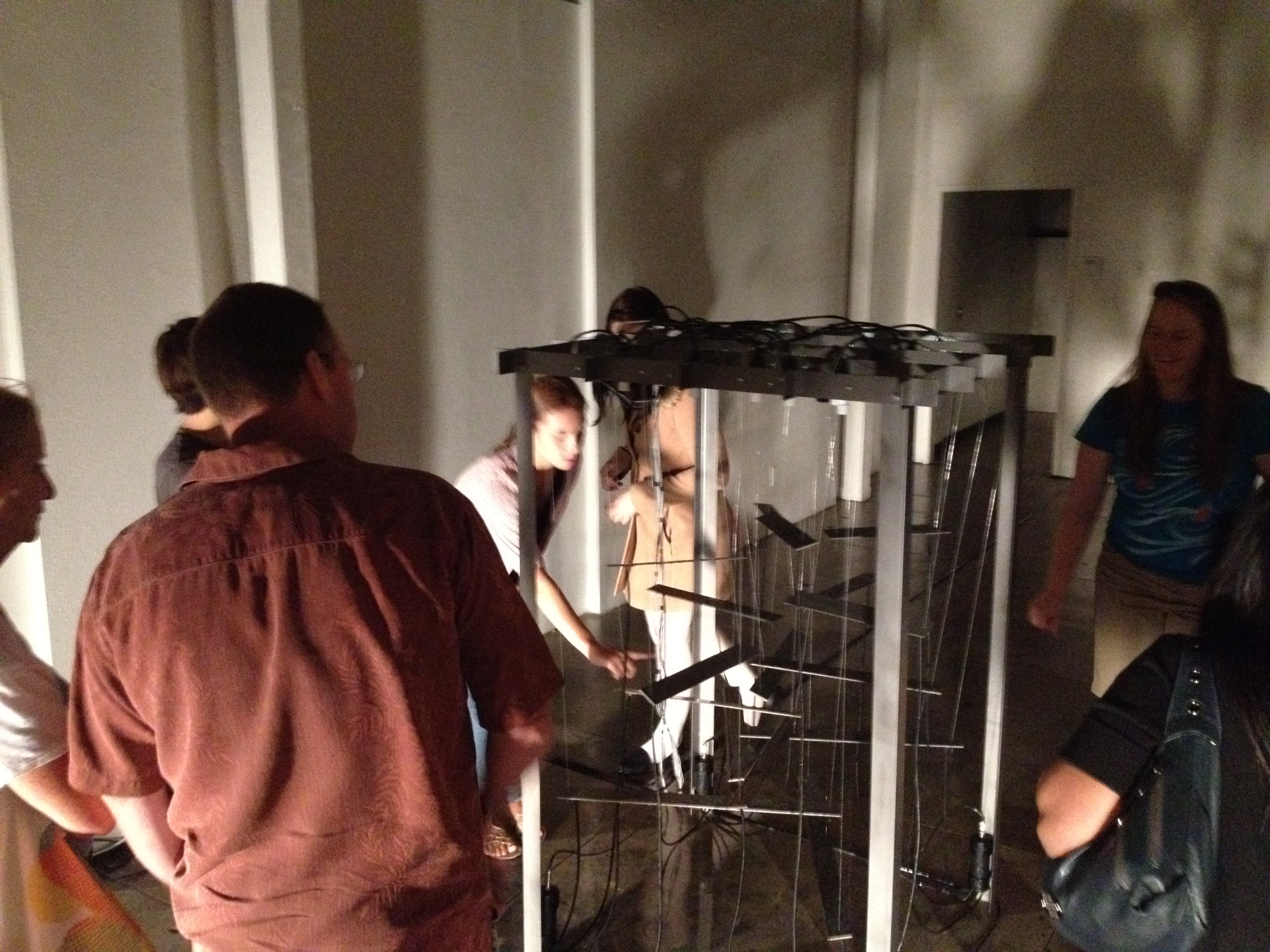
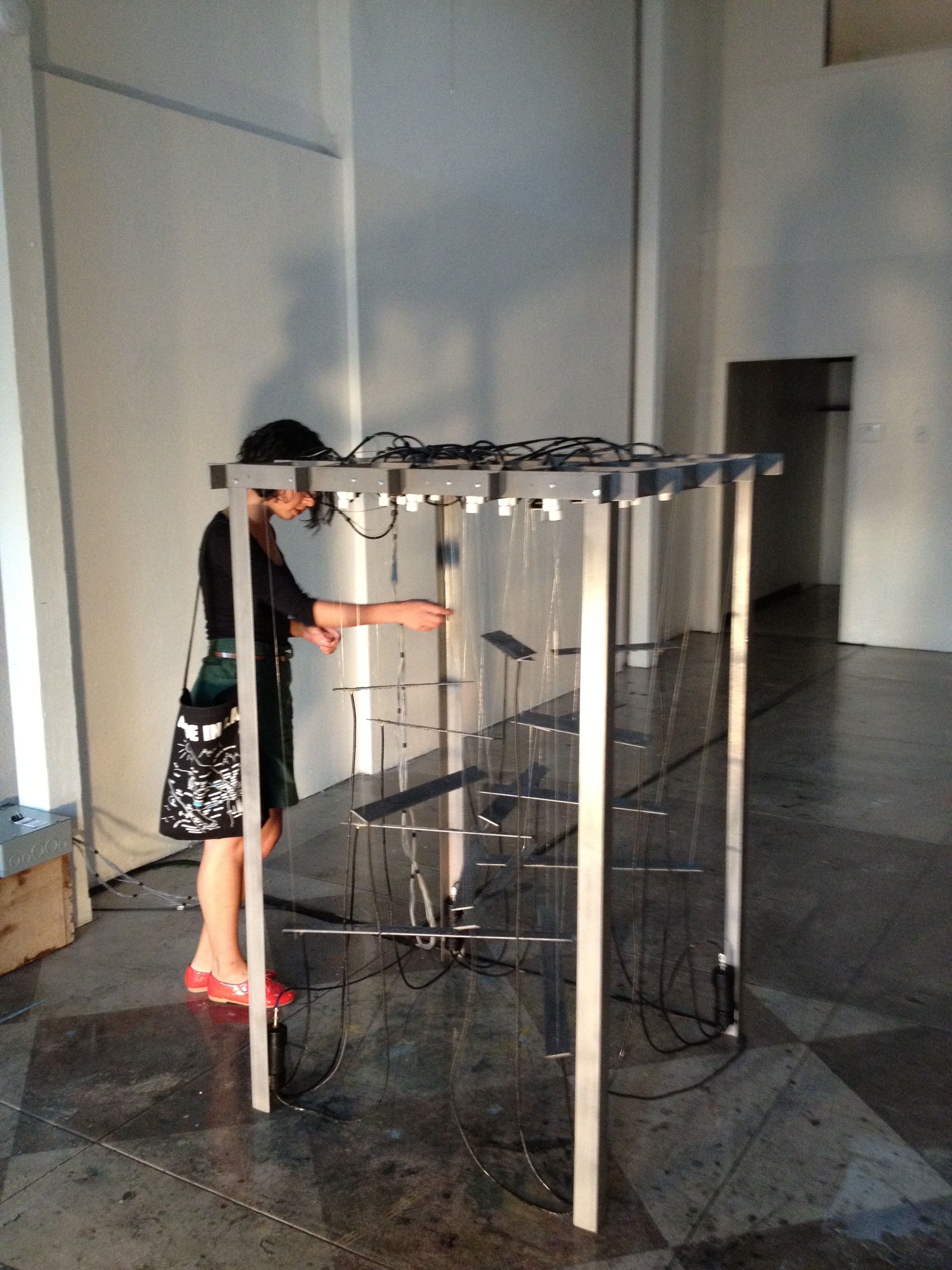
Last Saturday we showed Drip at the 2012 Soundwalk outdoor music festval in Long Beach, CA. The audience seemed to really engage with it and we heard lots of great feedback. In the past we’ve only installed it outside, so this was a pretty strange experience. A puddle quickly gathered on the floor and looked quite dangerous with all the power cables running everywhere, so a few people were too scared to go near it! Most just came right up and started playing though. This is one of the videos that was taken- unfortunately whoever shot it didn’t realize that the piece is a collaboration with Muhammad Hafiz so his name wasn’t included in the credits.

Here are a couple photos from the show:

Code DSP Tutorial

Linkwitz-Riley Filters

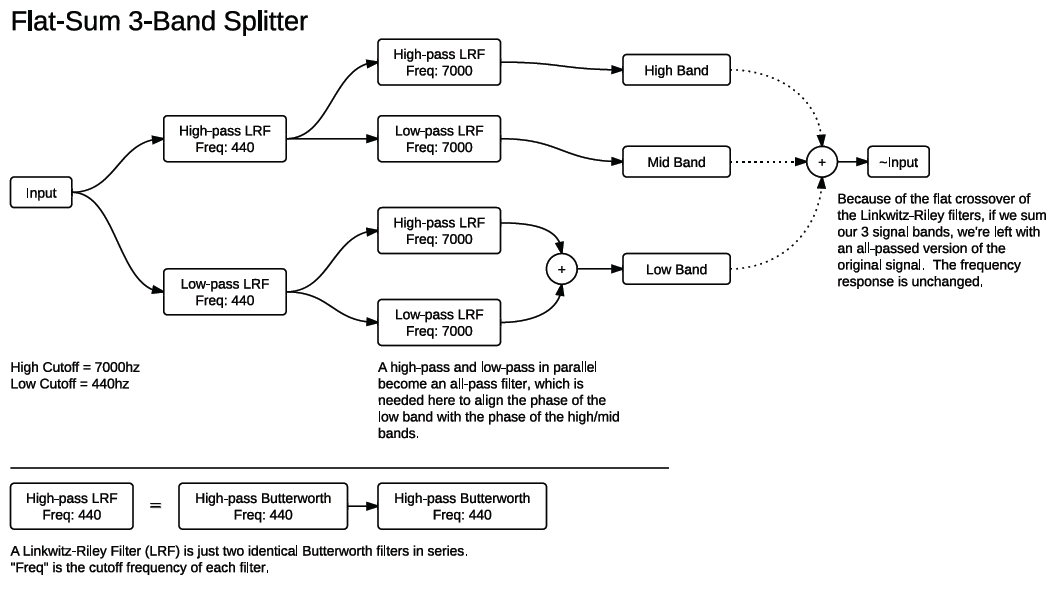
If you’re trying to split an audio signal into three frequency bands without using a costly FFT, the Linkwitz-Riley Crossover technique is a great solution. A Linkwitz-Riley filter is just two identical butterworth filters in series (because of that it’s sometimes called the “Butterworth Squared” filter), which has the unique identity of a perfectly flat crossover point. This means that if you pass a signal through a low-pass and a high-pass version and add the result, you’ll basically get back your original signal (all-passed).

This is a schematic of a 3-band splitter using this principle. Basically, one audio signal is being split in half and then split in half again, giving us 3 separate bands. The only weird thing on the diagram is the two filters in parallel on the low band. These are necessary to align the phase of the bottom with the top two bands. Every time a signal passes through one of these LR filters it gets its phase shifted, so if the bottom band only goes through one filter and the top two bands go through two (one initial and one after the split) then they’ll be out of phase with the bottom and you get bad dips and peaks in the frequency response.

Many, many thanks to Robin Schmidt, a.k.a. RS-MET for help with this tutorial.

Music

Film Reel

A collection of recent cinematic compositions:

1. Tribute to Edward Artemyev

This composition is a study on the work of Eduard Artemyev, the Soviet composer who scored Andrei Tarkovsky’s film “Stalker.” I’m specifically trying to copy the mood of the film’s post-intermission opening sequence, for which Artemyev created a great mix of eastern and western musical identities. The video is a montage of scenes from the movie in chronological order (Tarkovsky’s cinematography never ceases to amaze me…)

2. Futuristic Mechanical Pop

[audio:http://www.amusesmile.com/Music/algodub4.mp3|titles=Industrial Getaway]

3. Atmospheric Piano

[audio:http://amusesmile.com/old/sound/Geiringer.mp3|titles=Geiringer Hall]